

Explore how breakthroughs in electrochemical energy density are transforming electric aviation and extending into hybrid solar systems, safe energy storage, and infrastructure resilience.
Description: Explore how breakthroughs in electrochemical energy density are transforming electric aviation and extending into hybrid solar systems, safe energy storage, and infrastructure resilience—backed by current research.
Introduction
As global industries pursue decarbonization, electric aviation has become a proving ground for electrochemical storage innovation. Propel Aero, emerging from groundbreaking MIT research, aims to reach a pivotal milestone: 1,000 Wh/kg battery energy density.
At this level, regional electric flight transitions from concept to commercial reality. Studies suggest that at 1,000 Wh/kg, 80% of U.S. domestic flights could be powered electrically, enabling significant emissions reduction across aviation (ACS Publications; NASA Technical Reports).
Yet, the implications extend well beyond aircraft. Advances in battery chemistry, safety protocols, and hybrid energy systems are also shaping solar integration, data centers, and resilient infrastructure.
Bridging the Energy Density Gap
Current lithium-ion batteries typically achieve only 250–300 Wh/kg, falling far short of aviation requirements. Propel Aero's goal is to push electrochemical boundaries toward 1,000 Wh/kg, effectively tripling today's capacity. MIT has demonstrated sodium-air fuel cells with over 1,500 Wh/kg in laboratory tests, with projected real-world applications exceeding the 1,000 Wh/kg threshold.
Other chemistries—solid-state lithium, sulfur-selenium, and aluminum-ion—are under investigation, each offering higher energy density, lighter weight, or improved safety.
Safety Considerations and Aerospace Standards
Aviation batteries face stricter safety requirements than stationary storage. Risks such as thermal runaway are catastrophic in-flight. Propel Aero's design is engineered to surpass FAA standards, focusing on short-circuit protection, pack integrity, and resilience under extreme conditions. This safety-first design philosophy benefits ground applications such as AI data centers, where battery backup must ensure uptime without combustion-based risks.
Use Cases: Electric Drones and Regional Aircraft
Propel Aero's first applications are in unmanned aerial vehicles (UAVs). Enhanced gravimetric energy supports 10+ hour BVLOS flights, expanding defense, logistics, and environmental monitoring capabilities. With batteries approaching 1,000 Wh/kg, 80% of U.S. takeoffs and landings (short-haul flights) could transition to electric propulsion.
Cross-Sector Applications: From Data Centers to Solar Integration
Current reliance on diesel backup generators in AI data centers is unsustainable. FAA-grade safe, high-density batteries could replace diesel, improving resilience while reducing emissions. Pairing solar PV with advanced storage smooths output, ensuring power supply during cloud cover or nighttime—mirroring aviation needs where batteries act as backup generators when solar yield drops. NREL research confirms hybrid solar-storage systems increase reliability, dispatchability, and grid stability.
Vermont's Green Mountain Power demonstrates how home battery programs and microgrids enhance resilience, cutting costs while offering bi-directional grid services. When paired with aviation-grade electrochemistry, microgrids achieve greater safety and efficiency.
Aerospace Innovation Informing Solar Systems
Lessons from aerospace research are shaping solar infrastructure. Hybrid-electric aircraft studies inform energy dispatch models for solar + storage. The EFACA project provides frameworks for evaluating battery chemistries across industries. Architectures blending combustion and electric propulsion offer blueprints for hybrid energy systems.
Future Technologies in Solar-Battery Integration
- Structural Battery Composites – Dual-purpose materials that bear loads while storing energy, useful for drones, EVs, and solar canopy structures.
- Hybrid Inverters – Enable seamless switching between solar, storage, and grid input, optimizing efficiency.
- Photocharging Batteries – Emerging research on 2D carbon nitride solar batteries combines light capture and storage in one device, potentially boosting solar efficiency.
Supply Chain and Energy Security
Propel Aero emphasizes domestic sourcing of critical materials to reduce reliance on foreign supply chains. This aligns with national security priorities, particularly in defense contracts and AI data center infrastructure.
Conclusion
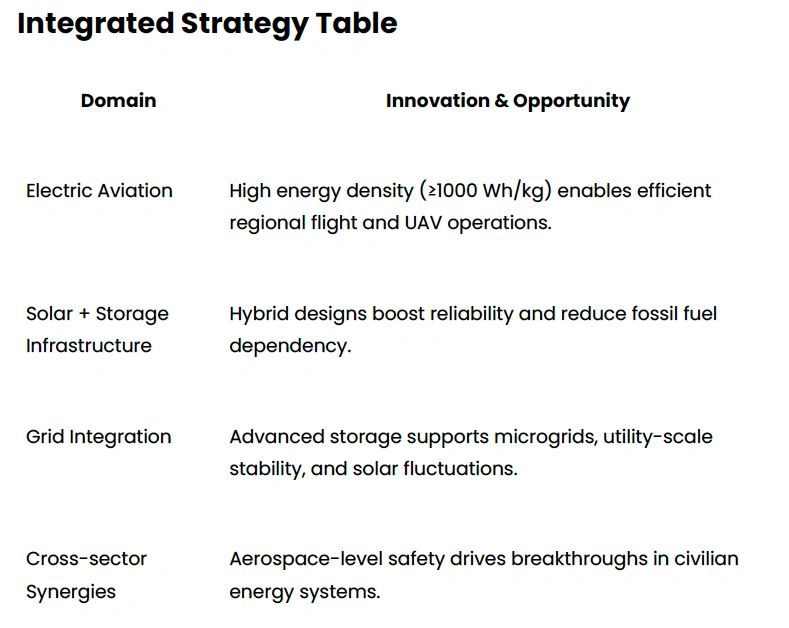
Propel Aero's breakthroughs in electrochemical innovation mark a tipping point for energy. Achieving or surpassing 1,000 Wh/kg unlocks electric aviation, particularly regional flights and UAVs. Aerospace-level safety cascades into solar + storage, AI data centers, and resilient infrastructure. By merging aviation-grade research with renewable infrastructure, industry leaders can accelerate carbon reduction, energy independence, and technological resilience across multiple sectors.